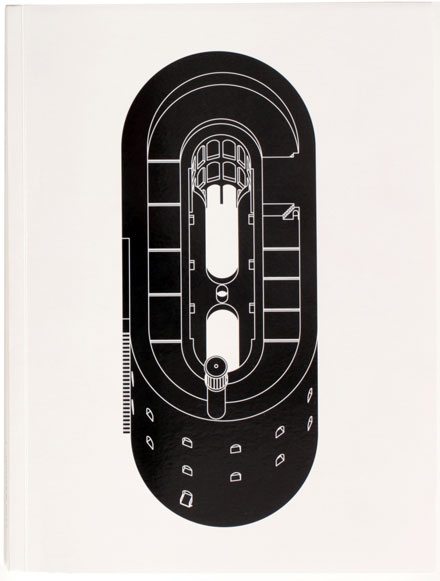
The Formula 1 championship was recently held at the Yas Marina Circuit in Abu Dhabi. It was the final race of the season, and the training sessions and the race itself were followed by millions of fans. Amidst the noise, the engines and the thousandths of seconds the cars gained over or lost to their adversaries, an enormous yacht appeared in the distance between the asphalt curves. The camera followed the cars, yet at the same time sought to sell the site where the race was being held by including aerial broadcasts of the circuit. The circuit is surrounded by water, so boats and even a port could be seen. It was in looking at these that one realized that the huge racetrack was located on an artificial island.
Yas Island, or “جزيرة ياس”, is one of the many large-scale projects constructed in the Persian Gulf, where millions of dollars (thirty-four billion dollars has been cited in the case of the racetrack) and major brands are being used to attract the general public, the masses. The racing circuit is one of these attractions. There is also a Ferrari theme park, a water park and a Warner Bros. Park, but above all, there are 1,700 hectares on which to develop 300,000 square metres of retail space. Everything is oversized and built on dredged sand. The profile of the coast was shaped by GPS, and all its twists and turns seek the spectacularity of a track inspired by Monaco’s street circuit. However, while the curves in Monaco are necessary for the racing circuit to fit into the city’s urban fabric, here everything has been simulated. Rather than taking advantage of the tabula rasa and proposing a new model, the builders of the Abu Dhabi track chose to copy or improve upon what already works. What is more, the copying is not direct but exponential. All of the track’s attributes have been multiplied so that it always comes out ahead of pre-existing circuits in a battle of numbers.
The question that everyone has in mind and no one will actually articulate is whether an investment of this kind in a complex half an hour outside the capital of Abu Dhabi will be profitable, or whether dredging so much sand to reclaim land from the sea is even necessary when there is already so much consolidated desert. The same question was posed a thousand times to Carl G. Fisher in the 1920s, and no one believed in him until he earned a fortune in Miami.
Fisher was one of the first developers to prove that more money could be made by investing in land flooded by salt marshes and mangroves than by investing in dry, consolidated land. The reason for this was the result of cheaper dredging systems and the Riparian Act of 1855, a law conceived to encourage commercial shipping and the dredging of channels and ports, thus ensuring a depth sufficient for larger vessels. This law, interpreted in a broader sense in the Riparian Act of 1921, allowed coastal landowners to fill in tidal floodplains. Sand could be dredged to consolidate the land, provided it was beyond the limits of navigation channels, and its most important feature was that it allowed warehouses, housing and other buildings to be built on it.
It all started when Fisher bought a holiday home in Miami in 1910. He was already a public figure by that time thanks to his business acumen and eccentricities. Self-made in the purest American sense, he started out marketing bicycles but then saw the potential of automobiles. His passion was speed, and he understood before others did that cars would become wildly popular and that people would even want to drive at night. Fisher therefore bought the patent for the acetylene gas lamps that were to become the first car headlights, before electric models were used. Fisher’s company produced most of the headlights used by the automotive industry and had manufacturing plants across the country. In 1913, he sold his Prest-O-Lite company to Union Carbide for nine million dollars and began his wanderings through the South to Miami in search of better weather.
Before devoting himself to industrially dredging channels, Fisher undertook several unique adventures that are worth mentioning. His passion for cars – in 1904 he held the world speed record of sixty miles per hour – led him to create a race-car track in his native Indiana in 1909. Injured in several illegal races, he found a way to finance an oval with very broad straightaways on which to race: the Indianapolis Motor Speedway. He committed to something that no one except racers considered useful. Yet it was a popular success, because people wanted to see these new gladiators in their iron wagons. The track’s inauguration was a very rough affair, because of its crushed-stone-and-tar pavement. Right after the start, the fragments of stone thrown off by the competitors became shrapnel that fatally riddled a driver, two mechanics and two spectators. As a result, the entire circuit was re-paved with bricks – a feat accomplished in just sixty-three days – and renamed “The Brickyard”. How far these Indianapolis bricks are from the fine Greywacke (a variety of sandstone generally characterized by its hardness, dark colour and poorly sorted angular grains of quartz, feldspar and small rock fragments or lithic fragments set in a compact, clay-fine matrix) used in the Yas Marina Circuit! The Abu Dhabi pavement offers the best grip in the world.
After a mere hundred years, Fisher’s old headlights, which exploded upon the least provocation because of the unstable gas they employed, have been replaced by bulbs that illuminate the entire area, thereby creating the world’s largest illuminated space. Everything in Yas Marina earns the tagline of “the world’s largest” – Carl G. Fisher’s tagline. Fisher, too, had sought to create business by entertaining the masses and to do so he had to do something unprecedented on a worldwide level. In 1911, the Indianapolis 500 was held for the first time, and eighty-seven thousand people paid a dollar to attend the race. Once again, Fisher had understood what people wanted and where the demand was.
Fisher also invested in motorways by designing and promoting the Lincoln Highway (1913), the first highway to cross the country from New York to San Francisco, and the Dixie Highway (1914), which linked his native Indiana to his adopted land of Miami and was subsequently extended to Montreal. In fact, what he did was to build the necessary infrastructure to reach his business interests in Florida – highways on which motorists could not travel at high speeds and which have nothing in common with the highway linking Dubai and Abu Dhabi and the main access to the Yas Marina Circuit. This latter highway’s five lanes in each direction – virtually empty, but with the highest proportion of Ferraris per driver – would certainly have been Fisher’s dream of Eden.
But we must return to the question at hand, one which eventually become Fisher’s greatest venture: the creation of Miami Beach. While in his new home in Miami, where he spent the winter season, he was surprised at how cheaply land could be reclaimed from the sea. It all started when a dam was erected to protect the little dock behind his house. Fisher saw the potential of dredging, of creating new coastland with the best possible views.
He teamed up with John Collins, who at that time was building a bridge to link Miami with the channel of the sea on the far side of Biscayne Bay. The place was infested with mosquitoes and a mangrove forest that only turtles and snakes could navigate. Collins built a 2.5-kilometre-long wooden bridge to gain access to his lands across the bay, where he dreamed of establishing an avocado plantation. Fisher lent him 50,000 dollars to finish the bridge and received as collateral 200 acres to the south of the arm of the sea, the site that would eventually become Miami Beach.
It took fifteen years to reach agreements with the Collins family and other owners to buy their land and to fill in the marshes with sand. Fisher managed to triple the area encompassed by the mangroves and made the terrain reach one mile wide. By dredging, he also managed to increase the water’s depth and allow recreational boats to get close to this new artificial coast. This magnificent oceanfront site was untouched and ready to be occupied by thousands of people, who had to reach it by travelling down Fisher’s highway. Polly Redford describes the situation in her book Billion-Dollar Sandbar: A Biography of Miami Beach (E. P. Dutton, New York, 1970, pp. 71–73):
In the summer of 1913 new land began rising from the bay at the South end of the Beach where Fisher and his business associates spent $600,000 replacing a thousand acres of mangroves with six million cubic yards of fill. The forest was cleared by gangs of Negro labourers armed with saws and axes. They worked hip-deep in mud, a pall of smoke hanging over them because smudge pots and bonfires of palmetto fiber were the only available defense against clouds of mosquitoes and sandflies that made life miserable for men and mules alike. When the many-branched mangrove roots proved ruinously expensive to remove, they were cut off two feet above the mud and left there for dredges to cover later on. At the water’s edge, steam shovels heaped the bay bottom into dikes while pile drivers sank rows of supports for a bulkheaded shoreline of wooden timbers anchored to pilings with steel cables. The shoreline alone cost $10 a running foot. Behind it, long pipelines reached from the mangrove stumps to the bay where suction dredges borrowed into the bottom, turning the water a muddy milky white. Fisher’s largest dredge, the Norman H. Davies, could pump fill trough a mile of pipe, and in places where this was not far enough, another dredge was rigged in tandem to boost the pressure . . .
So year by year, a uniform, five-foot plateau spread northward along the bayfront. As it rose, the bay bottom fell, and what had been hundreds of acres of turtlegrass flats covered with a foot or two of clear water became a deep, turbid pool running parallel to a smoothly bulkheaded shore. In this manner, the original landscape was erased as if had never been and a more saleable one built in its place.
The problem was that nobody understood Fisher’s vision. He had already spent two million dollars by 1917 and had the accesses and infrastructure ready to be able to sell the plots, but there was no demand. He therefore turned to his skills as a salesman, just as he had when he had sold bikes or cars. What he did – which was to look for celebrities – now seems obvious. He hired movie stars and sports figures to attract the public through the media. David Beckham’s dapper profile was not in style at the time, so he turned to swimmer Johnny Weissmuller, who later came to worldwide fame as Tarzan, and to golfers such as Bobby Jones and even an elephant caddy known as Rosie. Fisher bought the baby elephant, which was always featured in the advertisements he commissioned in newspapers and national magazines, in order to ingratiate himself with families. He needed something to counteract the effect of girls photographed in very short, provocative swimsuits. His famous winter campaigns – when half the country was covered in snow – used to feature photographs of pin-ups on the beach as a reminder that the sun always shines in Miami. In the 1999 PBS documentary Mr. Miami Beach, they expressed Fisher’s approach: “We’ll get the prettiest girls and put them in the goddamndest tightest and shortest bathing suits, and no stockings or swim shoes either. We’ll have their pictures taken and send them all over the goddamn country!”
In 1921 when President Warren G. Harding visited Miami, Fisher managed to “kidnap” him so that he would stay a week at the brand new Hotel Flamingo, which featured authentic Venetian gondolas with Italian gondoliers garbed in striped jersey uniforms. The chronicles say that the president stayed there the week immediately after he was elected, during the lame-duck government. He had a few days free and Fisher managed to keep him in the hotel by plying him with whisky and organizing poker games. In exchange, Fisher received the best publicity possible when the president proclaimed: “This beach is wonderful. It’s developing like magic. I hope to come here again” (Mr. Miami Beach, PBS documentary, 1999).
His message was widely covered in the news, because that same day, he had played a game of golf with Rosie as his caddy, which made both the elephant and the politician tremendously popular. And, of course, the American people heeded their President by flocking to Miami, thereby sparking the Florida boom of the 1920s. David McCullough, the host of Mr. Miami Beach, described the scene as follows:
People all over America began to empty their bank accounts, pack the family car and join the exodus rolling down Carl Fisher’s Dixie Highway to Florida. Six million of them came in three years, all determined to get their share of the Florida miracle. When they arrived they found a real estate gold rush in progress. Overflow crowds slept in the parks and pored over Sunday papers with 500 pages of real estate ads. Caravans of buses from the upper midwest brought thousands of prospects on tours of new developments. Seventy-five hundred real estate licenses were issued in Miami in 1925. Subdivisions sold out the day they went on the market. One office sold thirty-four million dollars’ worth of property in a single morning. Prices soared, and speculators rushed in. For a hundred dollars down, anyone could get in on the action, buying and selling land without ever setting foot on it.
Millions of people headed south in search of the climate and the home of their dreams. Growth was so fast that in just three years there were already 56 hotels, over 800 luxury villas, eight bathing pavilions, three polo fields, three golf courses and the best church in Florida . . . all in Miami Beach. Fisher once again promoted races, this time at sea aboard speedboats. They served to demonstrate the status of their owners, as well as the status of the new islands Fisher was creating. He built oval islands in the bay, such as the Venetian Islands and Star Island, which are very reminiscent of the Indianapolis Motor Speedway. The latter island measures half a mile long and a quarter mile wide. And benefitting from the I. I. Board’s norm, which allowed sandbanks of less than three feet deep at high tide and not separated from land by more than five feet to be filled in, he bought a flooded sandbank from the state for 17,000 dollars. He subsequently filled it in with sand and managed to sell it for 200 dollars per foot of coast through dredging, making enormous profits. Star Island became a sanctuary for celebrities, including the likes of Al Capone, who died there, and Don Johnson, who sailed in its waters dressed in Armani in the Miami Vice series. Shaquille O’Neal, Lenny Kravitz, Will Smith, Gloria Estefan, Madonna, P. Diddy and Sylvester Stallone live or have lived there.
This success is also being sought by Yas Marina, which – consciously or unconsciously – is copying some of Miami’s gimmicks. Ninety years later, prestige brands and the indiscriminate use of covert advertisement in the media are being relied on once again. False news reports are devised to show off idyllic hotels and views, and the public once again believes it is real. It is a place where the sun always shines, but where the temperatures make even peeking outside unbearable, where pin-ups are hidden behind their veils and where the “black labourers” that cleared mangroves have been replaced by “salaried Asian labourers” whose passports have been withdrawn to ensure their safety.
Miami was ravaged by a hurricane in September 1926. Hundreds of people were killed and many others were never found. As the ocean struggled to regain its territory, millions of residents cowered in fear. They were not locals. No one had explained anything to them, nor were they prepared to face nature. They were ignorant of the habitat they populated.
The city was flooded by three feet of sand and the real estate bubble burst. Fisher’s losses were considerable, and what he managed to hold on to was lost in the Crash of 1929. He ended his days in Key Largo at the Caribbean Club, the beach bar that was his last adventure, from which he viewed the sea, held at bay. This was the same Key Largo that inspired the film starring Humphrey Bogart and Lauren Bacall produced by Warner Bros., and the same Warner Bros. that now has a theme park at Yas Marina.
Ninety years later, the approaching storm is not natural but financial. The sand that rises up and batters its physical infrastructure will not be physical, but rather a social hurricane that results from a society with extreme socio-economic differences. And surely fear will rear its ugly head again, since millions of dollars are being held hostage in an unpredictable habitat.
Miami was saved thanks to its infrastructure, thanks to Fisher’s Dixie Highway, which allowed for various migrations and the city’s repopulation. Yas Marina, in contrast, has no motorways to connect it to large masses of people; it lacks that umbilical cord to the middle class. The models of the past must be studied if we are to know how to act in the future. And our mistakes must be validated in order for progress to be achieved. The hurricane is approaching. But rest assured that once the sand is removed, the set will still be standing for Warner Bros to make another Oscar-worthy film.