Logo Fundación Arquia
Logo

Centro de documentación FQ

Si aún no lo conoces te explicamos Qué es el Centro de Documentación FQ de Fundación Arquia

Contacto

Sede Oficinas

C/Barquillo, 6, 1º izda. 28004 Madrid

Sede Actividades Culturales

C/ Tutor, 16. 28008 Madrid

91 756 10 50

centrodocumentacion@arquia.es

Suscríbete

Suscríbete a nuestro boletín para estar al día de las últimas novedades y lanzamientos.

Al suscribirte, aceptas nuestra Política de Privacidad y das tu consentimiento para recibir actualizaciones de nuestra empresa.

© 2026 Centro de documentación FQ. Todos los derechos reservados.

Política de cookiesPolítica de privacidad
Centro de documentación FQ
InicioCatálogoCiclos
Logo

Centro de documentación FQ

InicioCatálogoCiclos
Competitions are Dead. Welcome to Proposals (Artículo publicado en (Non-)Essential Knowledge for (New) Architecture: 306090, Volume 15, Octubre 2013 , New York-Usa) Editor David L. Hays | Arquia - Centro de Documentación

Cargando realización...

  1. Inicio
  2. /Catálogo
  3. /Realizaciones
  4. /Competitions are Dead. Welcome to Proposals (Artículo publicado en (Non-)Essential Knowledge for (New) Architecture: 306090, Volume 15, Octubre 2013 , New York-Usa) Editor David L. Hays
RealizacionesPróxima

Competitions are Dead. Welcome to Proposals (Artículo publicado en (Non-)Essential Knowledge for (New) Architecture: 306090, Volume 15, Octubre 2013 , New York-Usa) Editor David L. Hays

Galería realización

Autoría y colaboradores

Autor

Eduard Sancho Pou

Información

Dirección

306090, Inc. 400 Degraw Street Brooklyn,

Fecha de fin

2013-10-15

Tipo de uso

Web y medios digitales

Sección

Próxima

IV Edición 2012-2013
2014

También te puede interesar

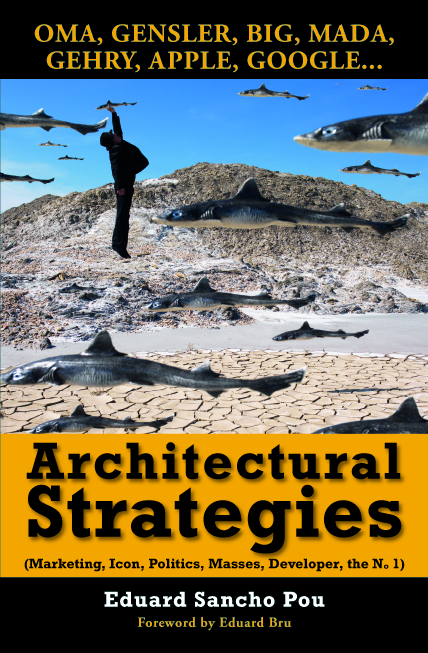
Architectural Strategies (Marketing, Icon, Politics, Masses, Developer, the no.1)
RealizacionesPróxima

Architectural Strategies (Marketing, Icon, Politics, Masses, Developer, the no.1)

TITLE: Architectural Strategies (Marketing, Icon, Politics, Masses, Developer, the no.1)

AUTHOR: Eduard Sancho Pou / Foreword by Eduard Bru

FORMAT: 15 x 23 cm

PAGES: 208 pages (ills colour & bw, 20 photographs)

BINDING: Paperback

LANGUAGE: ENGLISH

EDITOR: Ediciones Península (Grup 62 - Planeta)

ISBN: 978-84-9942-195-7

PRICE EU: 19,50 €

DISTRIBUTOR: IDEA BOOKS (www.ideabooks.nl) Idea Code 12489

Art Gensler, founder of Gensler, San Francisco: Global firm with more than 3,000 architects and 42 offices worldwide.

“I found your book fascinating and very well done. I believe your concepts in the article Gensler and OMA are correct.”

Bjarke Ingels, founder of BIG, Copenhagen and New York based group of architects. Visiting Professor at the Yale School of Architecture

“Eduard Sancho Pou interprets architecture from the point of view of what seems to work in the complex economic, political, commercial and social reality inherent in today’s global situation. A fresh take on architecture seen through strategy rather than theory.”

Stephen Bates, founder of Sergison Bates architects, offices in London and Zurich. Professor of Urbanism and Housing at TU München.

“The conclusions encourage greater strategic thinking, and this is the books’ most positive message because it promote action in practice, encouraging the architect to instigate, as much as to react.

Manel Gausa, dean of the Institut Arquitectura Avançada Catalunya (IAAC) and director of the Doctoral School of the University of Genova UNIGE.

“This book offers a fresh interpretation of the figure of the architect, which has always been linked to design and is now starting to be linked to entrepreneurial adventure, intellectual adventure and cross-sectional adventure, in which research is fundamental.”

Alfredo Pastor, professor of Economics at IESE Business School and holder of the Banco Sabadell Chair in Emerging Economies, Barcelona

"Architectural Strategies may seem harsh in that it views architects no longer as professionals, but as consultants. Architects must interpret their clients' needs and preferences. And this may lead to a change in the very concept of architecture, while granting priority to the developer's criteria, over any others.”

Qingyun Ma, dean of the University of Southern California’s School of Architecture and founder of the firm MADA spam, Shanghai

"If architecture is about coherent processes, Architectural Strategies starts from disruptive opportunities."

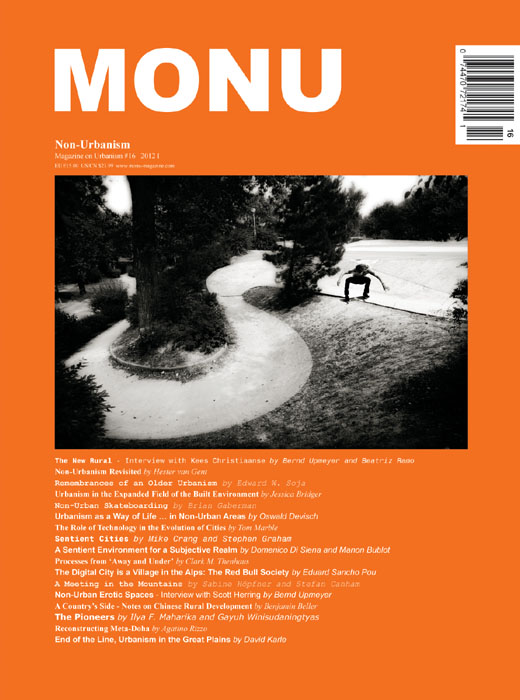
The digital city is a village in the Alps. The RED BULL Society.  (Artículo publicado en MONU #16 - NON-URBANISM, Abril 2012,  Rotterdam- Holanda)
RealizacionesPróxima

The digital city is a village in the Alps. The RED BULL Society. (Artículo publicado en MONU #16 - NON-URBANISM, Abril 2012, Rotterdam- Holanda)

In the digital city, I am awakened by a cow. Not its lowing, but rather its bell, clanging louder than the loudest alarm clock. I am in Fuschl am See, a charming Austrian village on the edge of a no less charming lake. Idyllic all around, wooden houses everywhere ringed by mountains. Just 10 minutes away is St. Gilgen, where Mozart's mother was born and 20 minutes away along a winding road is Salzburg, the city of music. But Fuschl am See is also home to Red Bull, the multinational that sells the world’s most famous energy drink and has revolutionized the concept of sports sponsorship. All of this happens from here, from a place where everything seems terribly boring and isolated from the world. No one would say this village is a digital city.

The changes are subtle. The hotel is sturdy and comfortable. I go down to breakfast and the entire buffet is terribly Austrian, even the coffee. At one table sits Sebastian Vettel, the Red Bull Formula 1 racer. He is accompanied by a few people who are also wearing T-shirts bearing icons of the drink, because the stars Red Bull sponsors come here to train, to take part in the stage. And most of all to have photos taken with which to flood the digital world. Today it is Sebastian, but yesterday it was Henry, the famous soccer player from the French national team who has left Barça to join the New York Red Bulls. They come to a town where no one bothers them, where fame has no consequences, to enhance that fame worldwide.

I leave the hotel and stroll around the village. There is a church, a school, two supermarkets and a slew of houses and apartments for rent. There is a pier overlooking the lake and public swimming pools. All comfortable. All quiet. All exactly the same. You can’t tell who is rich, because the truth is that they are all rich in their own way, since they live in such a privileged place.

Across the road at the end of town are the Red Bull Gmb headquarters. The two main buildings are cones with sliced-off points. The client wanted them to be crater-shaped and somehow it is true that the fire is alive and that infinite data are transmitted to the digital network from there. Four hundred people from all over the world work here. The lingua franca is English and everyone appreciates the quality of life and level of Austrian taxes, one of the EU’s lowest. They are just passing through. Their houses and cars are paid for, because in this new Levittown, you need a car to breathe, to live and especially to escape from such perfection.

The Company controls everything. The Company pays the meals of its employees, who are free to choose the restaurant they wish to dine in every day: the pizzeria by the lake, the sober hotel or the new hotel. They are housed in Company housing. All of it is lovely. And if you rise up in the Company, you have more and more windows with views. It is not a gated community on a physical level. There are no visible barriers, because all the barriers are intangible. If you get sacked, you cannot stay. First, because there is no available supply. Red Bull has bought everything up. Or at least it bids on everything, disrupting the market, while enhancing the value of its assets because of the lack of demand it constantly creates. It has become a feudal lord only because of its employees, a lord that everyone - from hoteliers to politicians - never cease to entertain, because they know that without it they’d never be on the map. In the geographical sense yes, but not digitally.

The new communities bear little resemblance to the gated communities that have been sold to us at astronomical prices until recently. We were led to believe that the future would take place behind a fence with private security, a clubhouse, tennis court and a heated pool. Big mistake. Those barriers that separated us from the world had the function of uniting us with our neighbours, so we could socialize. Of creating a perfect world away from the pollution of the outside world. A mistake, because many people turned to mortgages they cannot keep up with in order to buy that house and furniture and all the rest. And all these amenities, these private gardens and private pools and private security guards are the first to go when you’re broke. The problem is that if you don’t pay, your loving neighbours begin to hate you, to point to you as a debtor and install fingerprint detectors to bar entry to the clubhouse. And that's when you realize that the enemy is inside your residential estate and that this entire wonderful community life is based exclusively on paying fees - and that if the fees are not paid, it means war. People try to sell the houses and nobody wants to buy them, since they are so costly to maintain; it all falls apart with an air of impending doom. In contrast, everything in Fuschl am See is discreetly cosy. Probably because there is a mechanism to ensure your expulsion if you’re not useful to the system. The territory will unceremoniously eject you. In digital cities, the barriers are not physical, but rather economic.

I get in the car and head down the road. I see greenery and cows, but mostly order. My specific destination is Salzburg Airport, Hangar 7. The Navigator takes me there directly. The entire building is made of glass. It's an enormous nave designed to attract the public. On one side is a street and a huge parking lot; on the other, a runway. You enter the hanger and a billionaire’s toy museum appears. Formula 1 cars, race cars, planes, helicopters, jets, all of which are spattered with Red Bull logos. It is a combination museum-gallery that sells glamour. It peddles Red Bull’s image to fans, consumers and TV viewers. It's a trade show with a permanent venue where the products are changing constantly. Across from it is Hangar 8, a machine shop where newly landed artefacts from all over the world are cleaned up. And when they are ship-shape and ready once again, they are taken to Hangar 7 for the public’s enjoyment.

You can eat, drink coffee or buy souvenirs in Hangar 7. You can have a drink at the bar with glass floors suspended from the ceiling. And you think you might see or photograph a star there. It is a huge plateau with lights and music that seeks to generate its own content every day to sell an image, a brand. And few of us realize that it is actually a set where we are turned into characters in the Truman Show.

The key to the digital city is ubiquity, omnipresence. Being able to spread your message anywhere in the world. And to do so, all you need is enough runway to pick up speed and lift. From above, only greenery and more cows can be seen. We can only detect digital cities through the media.


Architecture must follow the strategy of music: sharing. (Comunicación presentada en el International Conference ACSA 2012, Barcelona)  http://acsa-arch.org
RealizacionesPróxima

Architecture must follow the strategy of music: sharing. (Comunicación presentada en el International Conference ACSA 2012, Barcelona) http://acsa-arch.org

The music industry has undergone a revolution that was on the verge of destroying it. In just over ten years, the public has stopped buying CDs and started downloading music. They have gone from possessing something physical that used to be collected and had a certain value to downloading intangible MP3 files that cost almost nothing. And the industry is beginning to adapt to this new situation, which has caused income to be generated from live concerts, subliminal advertising and digital royalties.

Architects are as baffled now as record companies were then. The bursting of the housing and subprime mortgage bubble has created a new scenario. What once had value and was secured by appraisers and banks has evaporated.

People are rethinking the need to own things, be it a home or a CD. The important thing is not to own something, but to enjoy it, and pay for it when you need it. Why store hundreds of CDs, if you can keep them on an iPod? Possession is a luxury only available to collectors and mythomaniacs. Enjoy the music you like and simply delete it when you are no longer interested in it. And this concept is moving into all areas, including architecture. Why do I need to buy a home if my job or my partner may take me to live in another city at any time? Why do I need a three-bedroom apartment if I live alone? If guests come, there are websites that will provide me with a spare room just a few metres from my house where I can put them up. Because the use of community resources is what the Internet offers. And that's more than saving. It’s sharing and creating a society that does not waste.

Music is 10 years ahead of architecture; let’s take advantage of its experience.