Logo Fundación Arquia
Logo

Centro de documentación FQ

Si aún no lo conoces te explicamos Qué es el Centro de Documentación FQ de Fundación Arquia

Contacto

Sede Oficinas

C/Barquillo, 6, 1º izda. 28004 Madrid

Sede Actividades Culturales

C/ Tutor, 16. 28008 Madrid

91 756 10 50

centrodocumentacion@arquia.es

Suscríbete

Suscríbete a nuestro boletín para estar al día de las últimas novedades y lanzamientos.

Al suscribirte, aceptas nuestra Política de Privacidad y das tu consentimiento para recibir actualizaciones de nuestra empresa.

© 2026 Centro de documentación FQ. Todos los derechos reservados.

Política de cookiesPolítica de privacidad
Centro de documentación FQ
InicioCatálogoCiclos
Logo

Centro de documentación FQ

InicioCatálogoCiclos

Cargando realización...

People, problems and cities behind numbers (Articulo publicado en Conditions 5/6 Octubre 2010, Noruega) | Arquia - Centro de Documentación
  1. Inicio
  2. /Catálogo
  3. /Realizaciones
  4. /People, problems and cities behind numbers (Articulo publicado en Conditions 5/6 Octubre 2010, Noruega)
RealizacionesPróxima

People, problems and cities behind numbers (Articulo publicado en Conditions 5/6 Octubre 2010, Noruega)

Galería realización

Descripción

Leaping from numbers to people, to social concerns, is one of the architectural mediator’s overriding goals. The connection between architecture and politics cannot be understood without this professional, who - either from within the Administration or from the sidelines - is key to the development of big cities and handles copious budgetary flows of public monies.

Daniel Patrick Moynihan (Tulsa 1927- Washington 1993)

Daniel Patrick Moynihan adroitly maintained the trust of the American government for forty years, regardless of the party in power. Capable of “inventing” the commissions that interested him, he also fought to preserve historic buildings, in addition to putting forward his own ground-breaking proposals.

Moynihan's forte was his talent for making connections and getting projects on the boil within the cloud of bureaucracy. He had a knack for knowing which senator to ally himself with and which senior official’s door to knock on; above all, his objectives were clear. Convincing others was a matter of numbers and data, never ideology. It was enough for him to understand the economic formula by which politics is governed.

In 1962, the White House commissioned him to draft a report that would justify the construction of new public office buildings in Washington. The last buildings erected in the capital by the Federal Government – the so-called “gray buildings” – dated back to the 1930s; they were massive, gray and somber. In Moynihan’s opinion, they seemed “determined to impress upon citizens how unimportant they are”.

Moynihan’s Report to the President by the Ad Hoc Committee on Federal Office Space included the need to renovate Pennsylvania Avenue. The mediator considered that its image should be changed, more uses provided and even a zone with housing defined. Moynihan knew that such a massive project could not be tackled hastily and he even let deadlines expire so as to be able to keep redefining the project and shape it to his interests. The renovation of this emblematic avenue, comparable with the Champs Elysees in Paris, would take 40 years to complete.

Together with the report, Moynihan presented his Guiding Principles for Federal Architecture, which over time became the guidelines for American public architecture.

GUIDING PRINCIPLES FOR FEDERAL ARCHITECTURE

1. The policy shall be to provide requisite and adequate facilities in an architectural style and form which is distinguished and which will reflect the dignity, enterprise, vigor, and stability of the American National Government. Major emphasis should be placed on the choice of designs that embody the finest contemporary American architectural thought. Specific attention should be paid to the possibilities of incorporating into such designs qualities which reflect the regional architectural traditions of the part of the Nation in which buildings are located. Where appropriate, fine art should be incorporated in the designs with emphasis on the work of living American artist. Design shall adhere to sound construction practice and utilize materials, methods, and equipment of proven dependability. Building shall be economical to build, operate, and maintain, and should be accessible to the handicapped.

2. The development of an official style must be avoided. Design must flow from the architectural profession to the Government and not vice versa. The Government should be willing to pay some additional cost to avoid excessive uniformity in design of Federal buildings. Competitions for the design of Federal buildings may be held where appropriate. The advice of distinguished architects ought to, as a rule, be sought prior to award of important design contracts.

3. The choice and development of the building site should be considered the first step of the design process. This choice should be made in cooperation with local agencies. Special attention should be paid to the general ensemble of streets and public places of which Federal buildings will form a part. Where possible, buildings should be located so as to permit a generous development of landscape

Vision+Voice, Design Excellence in Federal Architecture: Building a legacy (GSA, Dec. 2002), p. 4

Charles H. Atherton, Secretary of the Commission of Fine Arts said of these Principles: "They are so basic and so right in everything. You can’t do much better than that." Vision+Voice, Design Excellence in Federal Architecture: Building a legacy (GSA, Dec. 2002), p. 13. Guiding Principles was an invitation to escape from the official style in search of architectural excellence and involved hiring the finest architects of the day.

In the 1990s, these principles served to define the General Services Administrations’ Design Excellence Program, which sought out America’s most reputable architects to create buildings that would represent the administration. Thom Mayne of Morphosis, William Pedersen of Kohn Pedersen Fox Architects, Richard Meier of Richard Meier & Partners, Robert A.M. Stern of Robert A.M. Stern Architects and Charles Gwathmey of Gwathmey Siegel and Associates, among others, created courthouses and federal buildings, including the National Oceanographic Data Center in Washington, through the program.

Through his Guiding Principles, Moynihan defined the foundation on which American public architecture would be based. Several scholars consider them to be on a par with the Declaration of Independence in terms of importance.

The external consultant: Ricky Burdett

British architect Ricky Burdett (London 1956) represents a different type of urban consultant. Unlike Moynihan, who based his mediation work on his own political involvement, Burdett works from the sidelines of politics, placing himself at its service. In this sense, Moynihan’s work was easier. He knew which door to knock on; he had an organigram to identify what each post was responsible for, etc.. Convincing people was easier then.

However, Burdett is noted for his astute ability to root out the people who pull the strings of power, even in countries such as Brazil, China and Turkey, where he has successfully situated himself in a position to acquire influence. He has accomplished this by organizing seminars to which mayors and bankers are invited. His tactic: generating propitious opportunities for creating new business.

Burdett kicked off his career by running the 9H architecture gallery in London, which was launched as a result of the success of the specialized architectural journal of the same name and open to the public between 1986 and 1991. The gallery devoted itself to promoting continental European architects who were virtually unknown in London, some of the most outstanding of whom were Lily Reich & Eileen Gray, Álvaro Siza, Francesco Venezia, Eduardo Soto de Moura, Eduard Bru and Herzog & de Meuron.

The exhibitions 9H mounted were attended by architects, politicians, journalists and decision-makers. Thus, the gallery was Burdett’s accelerated apprenticeship in becoming a mediator, since it was a source of business contacts. In one exhibition, he forged a relationship with the American firm Skidmore, Owings and Merrill, which led to a two-year stint at the Chicago Institute for Architecture. Learning close up about the American Way of Life enabled Burdett to solidify ideas and generate the concept of the Architecture Foundation, an independent center for discussing architecture from a practical standpoint in a professionalized manner. In his desire to embrace civil society as a whole and provide a special place for cultural power, Burdett limited his professional colleagues to one-fourth of the number of seats on the board. He sought to bring together the country’s cultural and economic elite, since they are the ones who decide on a zone’s architecture in the end.

In 1992, the Architecture Foundation was consolidated with City Changes, an exhibition on the transformations London would be undergoing; it toured four different countries to widespread public acclaim. From his post as director, Burdett proved capable of anticipating problems and the potential reactions of the general public and sources of power. Once both were sounded, he managed to convince politicians of the best strategy to follow. They heeded him, because architecture translates into votes.

In 1993, Burdett became Architectural Adviser to the Tate Modern, which established his reputation as a mediator. He was largely responsible for deciding on the new Tate's location in an old power station set in the run-down neighborhood of North Southwark. The four million visitors this rehabilitated building receives each year attest to the sagacity of this choice of venue.

Based on the Tate’s success, Burdett became an advisor to the BBC, the mayor of London and even the mayor of Barcelona. In 1997, he resigned his post as Director of the Architecture Foundation and was signed by the London School of Economics. There he created a new department within the Faculty of Sociology - the LSE Cities Programme - which became the first design-based center in a school of social sciences. Mayors and urban planners eager for successful recipes to apply to their cities flocked to his classes.

In 2005, Burdett went one step further and created Urban Age, a more international and ambitious conference forum that goes beyond the sphere of London and takes on the world. The conferences are held in cities undergoing transformation that serve as examples for others: New York, the reinvented city; Shanghai and its booming growth; London, Burdett's own city and the one he knows best; Johannesburg, site of failed strategies; Mexico City, on the verge of collapse; and Berlin, with its declining population. Burdett brings to the table what works and what does not and encourages his students and researchers to find solutions.

Urban Age allows Burdett to be a global consultant, although he wields influence, not direct power, a situation similar to Moynihan’s when he was Ambassador to the United Nations before becoming a senator from New York. He could influence many countries, but enjoyed no real power. Until he was elected senator, the keys to the vault were not his.

Today Ricky Burdett is immersed in this duality. On the one hand, he influences many countries as a consultant with Urban Age. On the other, he is beginning to have access to power in London.

Burdett is the “principal design adviser” for the 2012 London Olympics, a post that consists of hiring design teams, supervising construction works and ensuring tight budgets and works that are delivered on time. In some ways, it is the same work he did for the Tate Modern, but on a scale some 20 or 30 times larger. Now the budget is bigger, there are more sites and the country’s stakes in making itself known to the world and positioning itself are higher.

Burdett must organize, choose and establish selection criteria. In his way, he has created his own Guiding Principles, like Moynihan’s:

“1) Firstly, the brief will always put design on an extremely high threshold, alongside deliverability and functionality. 2) We then go out and find the very best talent available for the job, regardless of profile. 3) Finally, we have mechanism in-house that ensure design quality is always balanced with restrictions such as time and budget” Let the games begin. Designbuild (Phin Foster, 1 Aug. 2007)

As a politician, like Moynihan, or as a consultant, like Burdett, the architectural mediator is an indispensable figure in urban development. Politicians, developers and architects need them to achieve coherent and functional urban growth that benefits citizens.

“Architects shape cities. Politicians make policies. Getting them to talk to each other is what interests me”. Brief encounter: Ricky Burdett. (Riba Journal v.112, Sept. 2005)

The words are Burdett’s, yet the great Moynihan would surely agree.

Autoría y colaboradores

Autor

Eduard Sancho Pou

Información

Dirección

Conditions Magazine, Fjordveien 3, NORUEGA

Fecha de fin

2012-01-13

Tipo de uso

Web y medios digitales

Sección

Próxima
III Edición 2010-2011
2012
IV Edición 2012-2013
2014

También te puede interesar

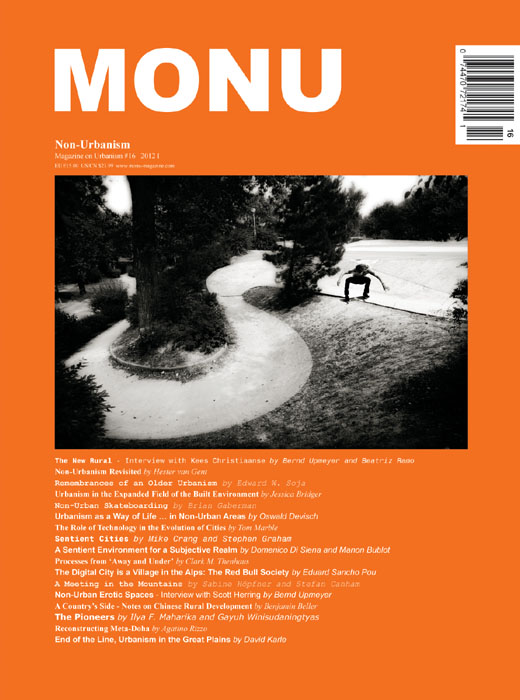
The digital city is a village in the Alps. The RED BULL Society.  (Artículo publicado en MONU #16 - NON-URBANISM, Abril 2012,  Rotterdam- Holanda)
RealizacionesPróxima

The digital city is a village in the Alps. The RED BULL Society. (Artículo publicado en MONU #16 - NON-URBANISM, Abril 2012, Rotterdam- Holanda)

In the digital city, I am awakened by a cow. Not its lowing, but rather its bell, clanging louder than the loudest alarm clock. I am in Fuschl am See, a charming Austrian village on the edge of a no less charming lake. Idyllic all around, wooden houses everywhere ringed by mountains. Just 10 minutes away is St. Gilgen, where Mozart's mother was born and 20 minutes away along a winding road is Salzburg, the city of music. But Fuschl am See is also home to Red Bull, the multinational that sells the world’s most famous energy drink and has revolutionized the concept of sports sponsorship. All of this happens from here, from a place where everything seems terribly boring and isolated from the world. No one would say this village is a digital city.

The changes are subtle. The hotel is sturdy and comfortable. I go down to breakfast and the entire buffet is terribly Austrian, even the coffee. At one table sits Sebastian Vettel, the Red Bull Formula 1 racer. He is accompanied by a few people who are also wearing T-shirts bearing icons of the drink, because the stars Red Bull sponsors come here to train, to take part in the stage. And most of all to have photos taken with which to flood the digital world. Today it is Sebastian, but yesterday it was Henry, the famous soccer player from the French national team who has left Barça to join the New York Red Bulls. They come to a town where no one bothers them, where fame has no consequences, to enhance that fame worldwide.

I leave the hotel and stroll around the village. There is a church, a school, two supermarkets and a slew of houses and apartments for rent. There is a pier overlooking the lake and public swimming pools. All comfortable. All quiet. All exactly the same. You can’t tell who is rich, because the truth is that they are all rich in their own way, since they live in such a privileged place.

Across the road at the end of town are the Red Bull Gmb headquarters. The two main buildings are cones with sliced-off points. The client wanted them to be crater-shaped and somehow it is true that the fire is alive and that infinite data are transmitted to the digital network from there. Four hundred people from all over the world work here. The lingua franca is English and everyone appreciates the quality of life and level of Austrian taxes, one of the EU’s lowest. They are just passing through. Their houses and cars are paid for, because in this new Levittown, you need a car to breathe, to live and especially to escape from such perfection.

The Company controls everything. The Company pays the meals of its employees, who are free to choose the restaurant they wish to dine in every day: the pizzeria by the lake, the sober hotel or the new hotel. They are housed in Company housing. All of it is lovely. And if you rise up in the Company, you have more and more windows with views. It is not a gated community on a physical level. There are no visible barriers, because all the barriers are intangible. If you get sacked, you cannot stay. First, because there is no available supply. Red Bull has bought everything up. Or at least it bids on everything, disrupting the market, while enhancing the value of its assets because of the lack of demand it constantly creates. It has become a feudal lord only because of its employees, a lord that everyone - from hoteliers to politicians - never cease to entertain, because they know that without it they’d never be on the map. In the geographical sense yes, but not digitally.

The new communities bear little resemblance to the gated communities that have been sold to us at astronomical prices until recently. We were led to believe that the future would take place behind a fence with private security, a clubhouse, tennis court and a heated pool. Big mistake. Those barriers that separated us from the world had the function of uniting us with our neighbours, so we could socialize. Of creating a perfect world away from the pollution of the outside world. A mistake, because many people turned to mortgages they cannot keep up with in order to buy that house and furniture and all the rest. And all these amenities, these private gardens and private pools and private security guards are the first to go when you’re broke. The problem is that if you don’t pay, your loving neighbours begin to hate you, to point to you as a debtor and install fingerprint detectors to bar entry to the clubhouse. And that's when you realize that the enemy is inside your residential estate and that this entire wonderful community life is based exclusively on paying fees - and that if the fees are not paid, it means war. People try to sell the houses and nobody wants to buy them, since they are so costly to maintain; it all falls apart with an air of impending doom. In contrast, everything in Fuschl am See is discreetly cosy. Probably because there is a mechanism to ensure your expulsion if you’re not useful to the system. The territory will unceremoniously eject you. In digital cities, the barriers are not physical, but rather economic.

I get in the car and head down the road. I see greenery and cows, but mostly order. My specific destination is Salzburg Airport, Hangar 7. The Navigator takes me there directly. The entire building is made of glass. It's an enormous nave designed to attract the public. On one side is a street and a huge parking lot; on the other, a runway. You enter the hanger and a billionaire’s toy museum appears. Formula 1 cars, race cars, planes, helicopters, jets, all of which are spattered with Red Bull logos. It is a combination museum-gallery that sells glamour. It peddles Red Bull’s image to fans, consumers and TV viewers. It's a trade show with a permanent venue where the products are changing constantly. Across from it is Hangar 8, a machine shop where newly landed artefacts from all over the world are cleaned up. And when they are ship-shape and ready once again, they are taken to Hangar 7 for the public’s enjoyment.

You can eat, drink coffee or buy souvenirs in Hangar 7. You can have a drink at the bar with glass floors suspended from the ceiling. And you think you might see or photograph a star there. It is a huge plateau with lights and music that seeks to generate its own content every day to sell an image, a brand. And few of us realize that it is actually a set where we are turned into characters in the Truman Show.

The key to the digital city is ubiquity, omnipresence. Being able to spread your message anywhere in the world. And to do so, all you need is enough runway to pick up speed and lift. From above, only greenery and more cows can be seen. We can only detect digital cities through the media.

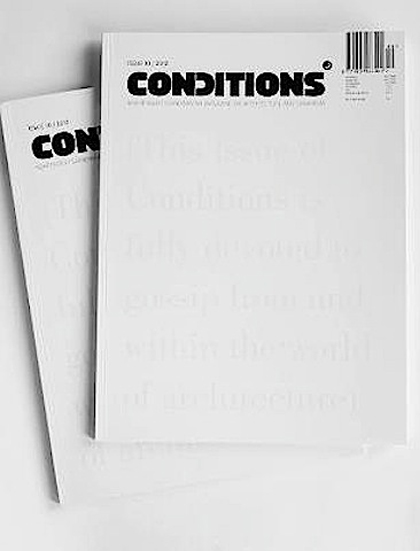
Gossip: And if most of the job offers are fake? (Artículo publicado en Conditions Magazine #10 – GOSSIP, Julio 2012, Oslo-Noruega)
RealizacionesPróxima

Gossip: And if most of the job offers are fake? (Artículo publicado en Conditions Magazine #10 – GOSSIP, Julio 2012, Oslo-Noruega)

Many firms are disappearing. Many firms are changing their way of working. Outsourcing is now standard use in architecture as well. In the same way that most call centres or IT managers in multinationals are in India or China, many architects move or hire rendering, calculation or delineation services outside the Western world. The reason: price competitiveness.

The problem is exacerbated when most projects are in countries such as China. Fees are paid based on a percentage of the construction prices, which in China are a third of what they are in the West.

“If you take a percentage and you work with western salaries, you can’t make it work,” Gehry said. “So it almost forces you to open an office in China and work with local people.” (Nadja Brandt – BusinessWeek: Oct 27, 2011)

If Gehry, with his awards and fame, cannot make the numbers work, it gives us an idea of ​​what the situation is like in other firms. Disastrous. Everyone is talking about it; we all have colleagues who talk about layoffs, reduced working hours and a bleak professional future. Yet, even so, jobs are offered on specialized websites each month. More and more skills, more and more experience, more and more of everything is being demanded.

Gossip has it that many of these jobs are simply advertising ploys. Firms want to make a show of brand strength to their clients and competitors. The jobs are not posted because of hiring needs, but rather to size up the market. By viewing résumés, they can assess their competitors and identify opportunities. What they have worked on; who their customers are and above all, the resources available to them. A recently fired employee is someone who easily responds to questionnaires from a possible employer. And that information makes the cost of the selection process well worth it.

I am referring to people who have the experience and knowledge about the processes of the studio, the ways of contracting suppliers, and getting clients. I am referring to role postings that include so much detail about the offer that even candidates are surprised about it, as only very few people meet the requisition profile. What seems to be incredibly accidental, it really is an invitation to fill a questionnaire/interview/form that will allow that company to increase the knowledge about it’s competitor.

Today, firms tend to outsource more and hire less in order to avoid fixed expenses. In times of crisis, surviving depends directly on not having ballasts. These employees that leave and will not be replaced are these that plot lines, draw facilities and make renders. That is all production and operation roles, which in the near past used to be the entry roles for graduate and internship architects.

The change comes with oDesk, a hiring portal that recruits operational roles. There are not glamorous, but rather functional. And just as Google is a search engine for websites, oDesk is a search engine for people looking for work.

A host of professionals look for work in delineation, calculation, facilities, renders, anything else you can think of and more, with the only limit being that is transmitted through the Internet. All at a negotiable price, either by hour or by job. There are offers at $4.33 per hour Autocad. Or $39.50 for the rendering of a building (fixed price project). These prices are possible because those who monopolize the ratings rankings are professionals from developing countries such as India, the Philippines, Egypt and China. People who are hired on the basis of the level of satisfaction of other clients, but also scores (Top Scorers) of their professional skills.

oDesk offers the ability to test for knowledge of Autocad, 3DMax, Illustrator, etc ... which can then be added to one’s résumé. Academic qualifications are useless here; what counts is what one shows one can do under the search engine’s filter and parameters. Until now, the Internet has been understood as the provider of opportunities and bargains. Restaurants/hotels/travel/clothing offers. Now we can add the offer of people to the list.

When the system rotates and you are the one who becomes a measurable, delimited commodity, you stop enjoying the “like” button. With Facebook, we have become used to airing our opinions of everything and everyone with a single click. Now everything has opinions on how we work.

One example is IBM. This month it has presented the "Liquid" program to its workers in Germany. Of their 22,000 employees, 8,000 will go from working for IBM to working with IBM. From fixed employees to free-lancers. (Source: Frei schwebend in der Wolke "IBM Radikalreform" - Der Spiegel: Feb 05.2012). From having a job to opting for tasks assigned by the company. The model "at another level" is the same as oDesk. Employees create a profile on a platform offered by IBM, where they demonstrate their skills, which can be completed with "Awards" if they get good scores on the tests the company conducts on a regular basis. To complete the picture, the "likeability" factor also appears, to show if your teammates and managers like collaborating with you.

The company saves on overhead, since they only hire when there is work. Yet, they make sure they have "human resources" always available to respond to commissions and projects effectively and immediately. This is the model that a profitable company, IBM, has adopted in a growing market such as IT and applied in a country with strictly employment regulations, such as Germany. If we think about architectural firms, which are in free fall because of the real estate crash, are there really any job openings?

I think so. I predict a job market that will be determined by what is transmitted over the network and what is not. When there is no work, what is most highly valued is the person who can find projects and opportunities for the studio/company. In the wake of the crisis, the most demanded vacancies are the traders: marketing coordinators, strategy specialists and brand consultants. Professionals who are capable of understanding the market and the demand, yet who can shore up a team to find solutions at the same time. Professionals who understand architecture as a system of strategies. Professionals who can sell architecture.

What surprises me is that architecture schools have not yet adapted to this reality and continue to implement curriculum as if there were no crisis that has changed everything, but also as if there were no new tools such as oDesk, which will transform things even more.

Postscript (PS): There is a restaurant guide, the 2012 Roc National Diners' Guide, which establishes a ranking of restaurants, depending on the conditions in which their employees work. Until now, we have wanted to know if the food was good at a restaurant and also if its products were organic or not. The next step is knowing what the working conditions are. Perhaps if we find out that the waiter earns very few dollars an hour (before tips), we will be scandalized by the bill for our romantic dinner and stop going.

I predict that the same thing will be true in architecture. Today we want architects to be capable of creating good projects and meeting deadlines and budgets. But we also want the use and operations to be environmentally-friendly. Where the wood comes from; if logging has been legal and the trees will be replaced. The next step is knowing the work conditions in which a building is planned. If the collaborating architect charges very little money for his work (tips are not possible in architecture), perhaps a customer or an administration will penalize a firm for such practices. In the end, gossips will be important, since they will affect our digital reputation.

All that is material will be standard, and all that is personalized will be virtual (Articulo publicado en Volume 28, Julio 2011, Amsterdam-Holanda)
RealizacionesPróxima

All that is material will be standard, and all that is personalized will be virtual (Articulo publicado en Volume 28, Julio 2011, Amsterdam-Holanda)

The largest migration in human history is looming. And if we are impressed now by Shanghai - with its ten million inhabitants - in 20 years, there will be ten new satellite towns in its perimeter, which will make the city swell to 100 million people.

To create hyperdense cities, architects must also think about the social relations to be established; they cannot limit themselves to constructing buildings. They must consider how to coordinate future life in the cities and help the public get ready to inhabit them.

The solution will tend towards an updated version of Levitt’s work. The way to optimize the production chain will be sought for reasons of sustainability and economic profitability. An efficient, cheap and quickly-built system needs to be defined to ensure minimum conditions of quality for the population. The solution must be a temporary one that consists in easily assembled, small accommodations clustered in high density. The housing’s uniqueness will need to be developed so that its inhabitants enjoy some degree of comfort. Just as the rise of the automotive industry made the commute to Levitt’s homes possible – which led to individualized travel –a technology that allows people to live in hyperdense cities will need to be developed.

The technology that will lead us to create this new way of life will be the virtual environment (the 3D environment of a fantasy world in which each person is represented by an avatar). New technologies change social relations as well as our personal experiences. We use them to replace basic aspects of our existence such as living, feeling and touching with browsing, accessing or customizing. We need another kind of reality that allows us to survive emotionally. The virtual world allows a person who lives in a huge block, in a giant hive, to keep one’s “virtual self” in the town where he was born and has always dreamed of living. It gives one access to what one cannot actually have or to the friends left behind in the move from the countryside to the city. The Chinese can adapt to this way of life because physical objects have no value except in the relationships they create. The new generations, who are teens today, no longer distinguish between the virtual and real worlds. It is all the same thing, although virtuality is closer to their way of understanding life. Instant messaging and Facebook allow them to be instantly close to their friends, music, vacations and interests. What they see on a daily basis is boring in comparison with the inputs they receive from their virtual friends. Their physical environment no longer is important if they have access to the Internet. And that is the citizen who can survive in an hyperdensified environment: someone who does not need the material public space because he or she will find it in the virtual space, someone who will find everything related to the personal virtually because physically he will not be able to pay for it or simply because it is not worth acquiring something that means a burden on their extreme mobility.

The shift has already begun. The virtual world is intertwined with reality. Renderings convince politicians and decide competitions that become built realities. Their glitter and lights attract the masses. The strange thing is that built architecture is ever closer to that virtual architecture.

In the end, all that is material will be standard, and all that is personalized will be virtual. Unique pieces will be unsustainable because of price and energy expenditure, if we wish to supply the masses. This may sound like science fiction, but the virtual world will be the technology we use to define the super-dense city.