Logo Fundación Arquia
Logo

Centro de documentación FQ

Si aún no lo conoces te explicamos Qué es el Centro de Documentación FQ de Fundación Arquia

Contacto

Sede Oficinas

C/Barquillo, 6, 1º izda. 28004 Madrid

Sede Actividades Culturales

C/ Tutor, 16. 28008 Madrid

91 756 10 50

centrodocumentacion@arquia.es

Suscríbete

Suscríbete a nuestro boletín para estar al día de las últimas novedades y lanzamientos.

Al suscribirte, aceptas nuestra Política de Privacidad y das tu consentimiento para recibir actualizaciones de nuestra empresa.

© 2026 Centro de documentación FQ. Todos los derechos reservados.

Política de cookiesPolítica de privacidad
Centro de documentación FQ
InicioCatálogoCiclos
Logo

Centro de documentación FQ

InicioCatálogoCiclos
Pin-ups, Racetracks and Baby Elephants, or How to Develop an Artificial Island Strategy (Articulo publicado San Rocco 1, Venecia - Italia) | Arquia - Centro de Documentación

Cargando realización...

  1. Inicio
  2. /Catálogo
  3. /Realizaciones
  4. /Pin-ups, Racetracks and Baby Elephants, or How to Develop an Artificial Island Strategy (Articulo publicado San Rocco 1, Venecia - Italia)
RealizacionesPróxima

Pin-ups, Racetracks and Baby Elephants, or How to Develop an Artificial Island Strategy (Articulo publicado San Rocco 1, Venecia - Italia)

Galería realización

Descripción

The Formula 1 championship was recently held at the Yas Marina Circuit in Abu Dhabi. It was the final race of the season, and the training sessions and the race itself were followed by millions of fans. Amidst the noise, the engines and the thousandths of seconds the cars gained over or lost to their adversaries, an enormous yacht appeared in the distance between the asphalt curves. The camera followed the cars, yet at the same time sought to sell the site where the race was being held by including aerial broadcasts of the circuit. The circuit is surrounded by water, so boats and even a port could be seen. It was in looking at these that one realized that the huge racetrack was located on an artificial island.

Yas Island, or “جزيرة ياس‎”, is one of the many large-scale projects constructed in the Persian Gulf, where millions of dollars (thirty-four billion dollars has been cited in the case of the racetrack) and major brands are being used to attract the general public, the masses. The racing circuit is one of these attractions. There is also a Ferrari theme park, a water park and a Warner Bros. Park, but above all, there are 1,700 hectares on which to develop 300,000 square metres of retail space. Everything is oversized and built on dredged sand. The profile of the coast was shaped by GPS, and all its twists and turns seek the spectacularity of a track inspired by Monaco’s street circuit. However, while the curves in Monaco are necessary for the racing circuit to fit into the city’s urban fabric, here everything has been simulated. Rather than taking advantage of the tabula rasa and proposing a new model, the builders of the Abu Dhabi track chose to copy or improve upon what already works. What is more, the copying is not direct but exponential. All of the track’s attributes have been multiplied so that it always comes out ahead of pre-existing circuits in a battle of numbers.

The question that everyone has in mind and no one will actually articulate is whether an investment of this kind in a complex half an hour outside the capital of Abu Dhabi will be profitable, or whether dredging so much sand to reclaim land from the sea is even necessary when there is already so much consolidated desert. The same question was posed a thousand times to Carl G. Fisher in the 1920s, and no one believed in him until he earned a fortune in Miami.

Fisher was one of the first developers to prove that more money could be made by investing in land flooded by salt marshes and mangroves than by investing in dry, consolidated land. The reason for this was the result of cheaper dredging systems and the Riparian Act of 1855, a law conceived to encourage commercial shipping and the dredging of channels and ports, thus ensuring a depth sufficient for larger vessels. This law, interpreted in a broader sense in the Riparian Act of 1921, allowed coastal landowners to fill in tidal floodplains. Sand could be dredged to consolidate the land, provided it was beyond the limits of navigation channels, and its most important feature was that it allowed warehouses, housing and other buildings to be built on it.

It all started when Fisher bought a holiday home in Miami in 1910. He was already a public figure by that time thanks to his business acumen and eccentricities. Self-made in the purest American sense, he started out marketing bicycles but then saw the potential of automobiles. His passion was speed, and he understood before others did that cars would become wildly popular and that people would even want to drive at night. Fisher therefore bought the patent for the acetylene gas lamps that were to become the first car headlights, before electric models were used. Fisher’s company produced most of the headlights used by the automotive industry and had manufacturing plants across the country. In 1913, he sold his Prest-O-Lite company to Union Carbide for nine million dollars and began his wanderings through the South to Miami in search of better weather.

Before devoting himself to industrially dredging channels, Fisher undertook several unique adventures that are worth mentioning. His passion for cars – in 1904 he held the world speed record of sixty miles per hour – led him to create a race-car track in his native Indiana in 1909. Injured in several illegal races, he found a way to finance an oval with very broad straightaways on which to race: the Indianapolis Motor Speedway. He committed to something that no one except racers considered useful. Yet it was a popular success, because people wanted to see these new gladiators in their iron wagons. The track’s inauguration was a very rough affair, because of its crushed-stone-and-tar pavement. Right after the start, the fragments of stone thrown off by the competitors became shrapnel that fatally riddled a driver, two mechanics and two spectators. As a result, the entire circuit was re-paved with bricks – a feat accomplished in just sixty-three days – and renamed “The Brickyard”. How far these Indianapolis bricks are from the fine Greywacke (a variety of sandstone generally characterized by its hardness, dark colour and poorly sorted angular grains of quartz, feldspar and small rock fragments or lithic fragments set in a compact, clay-fine matrix) used in the Yas Marina Circuit! The Abu Dhabi pavement offers the best grip in the world.

After a mere hundred years, Fisher’s old headlights, which exploded upon the least provocation because of the unstable gas they employed, have been replaced by bulbs that illuminate the entire area, thereby creating the world’s largest illuminated space. Everything in Yas Marina earns the tagline of “the world’s largest” – Carl G. Fisher’s tagline. Fisher, too, had sought to create business by entertaining the masses and to do so he had to do something unprecedented on a worldwide level. In 1911, the Indianapolis 500 was held for the first time, and eighty-seven thousand people paid a dollar to attend the race. Once again, Fisher had understood what people wanted and where the demand was.

Fisher also invested in motorways by designing and promoting the Lincoln Highway (1913), the first highway to cross the country from New York to San Francisco, and the Dixie Highway (1914), which linked his native Indiana to his adopted land of Miami and was subsequently extended to Montreal. In fact, what he did was to build the necessary infrastructure to reach his business interests in Florida – highways on which motorists could not travel at high speeds and which have nothing in common with the highway linking Dubai and Abu Dhabi and the main access to the Yas Marina Circuit. This latter highway’s five lanes in each direction – virtually empty, but with the highest proportion of Ferraris per driver – would certainly have been Fisher’s dream of Eden.

But we must return to the question at hand, one which eventually become Fisher’s greatest venture: the creation of Miami Beach. While in his new home in Miami, where he spent the winter season, he was surprised at how cheaply land could be reclaimed from the sea. It all started when a dam was erected to protect the little dock behind his house. Fisher saw the potential of dredging, of creating new coastland with the best possible views.

He teamed up with John Collins, who at that time was building a bridge to link Miami with the channel of the sea on the far side of Biscayne Bay. The place was infested with mosquitoes and a mangrove forest that only turtles and snakes could navigate. Collins built a 2.5-kilometre-long wooden bridge to gain access to his lands across the bay, where he dreamed of establishing an avocado plantation. Fisher lent him 50,000 dollars to finish the bridge and received as collateral 200 acres to the south of the arm of the sea, the site that would eventually become Miami Beach.

It took fifteen years to reach agreements with the Collins family and other owners to buy their land and to fill in the marshes with sand. Fisher managed to triple the area encompassed by the mangroves and made the terrain reach one mile wide. By dredging, he also managed to increase the water’s depth and allow recreational boats to get close to this new artificial coast. This magnificent oceanfront site was untouched and ready to be occupied by thousands of people, who had to reach it by travelling down Fisher’s highway. Polly Redford describes the situation in her book Billion-Dollar Sandbar: A Biography of Miami Beach (E. P. Dutton, New York, 1970, pp. 71–73):

In the summer of 1913 new land began rising from the bay at the South end of the Beach where Fisher and his business associates spent $600,000 replacing a thousand acres of mangroves with six million cubic yards of fill. The forest was cleared by gangs of Negro labourers armed with saws and axes. They worked hip-deep in mud, a pall of smoke hanging over them because smudge pots and bonfires of palmetto fiber were the only available defense against clouds of mosquitoes and sandflies that made life miserable for men and mules alike. When the many-branched mangrove roots proved ruinously expensive to remove, they were cut off two feet above the mud and left there for dredges to cover later on. At the water’s edge, steam shovels heaped the bay bottom into dikes while pile drivers sank rows of supports for a bulkheaded shoreline of wooden timbers anchored to pilings with steel cables. The shoreline alone cost $10 a running foot. Behind it, long pipelines reached from the mangrove stumps to the bay where suction dredges borrowed into the bottom, turning the water a muddy milky white. Fisher’s largest dredge, the Norman H. Davies, could pump fill trough a mile of pipe, and in places where this was not far enough, another dredge was rigged in tandem to boost the pressure . . .

So year by year, a uniform, five-foot plateau spread northward along the bayfront. As it rose, the bay bottom fell, and what had been hundreds of acres of turtlegrass flats covered with a foot or two of clear water became a deep, turbid pool running parallel to a smoothly bulkheaded shore. In this manner, the original landscape was erased as if had never been and a more saleable one built in its place.

The problem was that nobody understood Fisher’s vision. He had already spent two million dollars by 1917 and had the accesses and infrastructure ready to be able to sell the plots, but there was no demand. He therefore turned to his skills as a salesman, just as he had when he had sold bikes or cars. What he did – which was to look for celebrities – now seems obvious. He hired movie stars and sports figures to attract the public through the media. David Beckham’s dapper profile was not in style at the time, so he turned to swimmer Johnny Weissmuller, who later came to worldwide fame as Tarzan, and to golfers such as Bobby Jones and even an elephant caddy known as Rosie. Fisher bought the baby elephant, which was always featured in the advertisements he commissioned in newspapers and national magazines, in order to ingratiate himself with families. He needed something to counteract the effect of girls photographed in very short, provocative swimsuits. His famous winter campaigns – when half the country was covered in snow – used to feature photographs of pin-ups on the beach as a reminder that the sun always shines in Miami. In the 1999 PBS documentary Mr. Miami Beach, they expressed Fisher’s approach: “We’ll get the prettiest girls and put them in the goddamndest tightest and shortest bathing suits, and no stockings or swim shoes either. We’ll have their pictures taken and send them all over the goddamn country!”

In 1921 when President Warren G. Harding visited Miami, Fisher managed to “kidnap” him so that he would stay a week at the brand new Hotel Flamingo, which featured authentic Venetian gondolas with Italian gondoliers garbed in striped jersey uniforms. The chronicles say that the president stayed there the week immediately after he was elected, during the lame-duck government. He had a few days free and Fisher managed to keep him in the hotel by plying him with whisky and organizing poker games. In exchange, Fisher received the best publicity possible when the president proclaimed: “This beach is wonderful. It’s developing like magic. I hope to come here again” (Mr. Miami Beach, PBS documentary, 1999).

His message was widely covered in the news, because that same day, he had played a game of golf with Rosie as his caddy, which made both the elephant and the politician tremendously popular. And, of course, the American people heeded their President by flocking to Miami, thereby sparking the Florida boom of the 1920s. David McCullough, the host of Mr. Miami Beach, described the scene as follows:

People all over America began to empty their bank accounts, pack the family car and join the exodus rolling down Carl Fisher’s Dixie Highway to Florida. Six million of them came in three years, all determined to get their share of the Florida miracle. When they arrived they found a real estate gold rush in progress. Overflow crowds slept in the parks and pored over Sunday papers with 500 pages of real estate ads. Caravans of buses from the upper midwest brought thousands of prospects on tours of new developments. Seventy-five hundred real estate licenses were issued in Miami in 1925. Subdivisions sold out the day they went on the market. One office sold thirty-four million dollars’ worth of property in a single morning. Prices soared, and speculators rushed in. For a hundred dollars down, anyone could get in on the action, buying and selling land without ever setting foot on it.

Millions of people headed south in search of the climate and the home of their dreams. Growth was so fast that in just three years there were already 56 hotels, over 800 luxury villas, eight bathing pavilions, three polo fields, three golf courses and the best church in Florida . . . all in Miami Beach. Fisher once again promoted races, this time at sea aboard speedboats. They served to demonstrate the status of their owners, as well as the status of the new islands Fisher was creating. He built oval islands in the bay, such as the Venetian Islands and Star Island, which are very reminiscent of the Indianapolis Motor Speedway. The latter island measures half a mile long and a quarter mile wide. And benefitting from the I. I. Board’s norm, which allowed sandbanks of less than three feet deep at high tide and not separated from land by more than five feet to be filled in, he bought a flooded sandbank from the state for 17,000 dollars. He subsequently filled it in with sand and managed to sell it for 200 dollars per foot of coast through dredging, making enormous profits. Star Island became a sanctuary for celebrities, including the likes of Al Capone, who died there, and Don Johnson, who sailed in its waters dressed in Armani in the Miami Vice series. Shaquille O’Neal, Lenny Kravitz, Will Smith, Gloria Estefan, Madonna, P. Diddy and Sylvester Stallone live or have lived there.

This success is also being sought by Yas Marina, which – consciously or unconsciously – is copying some of Miami’s gimmicks. Ninety years later, prestige brands and the indiscriminate use of covert advertisement in the media are being relied on once again. False news reports are devised to show off idyllic hotels and views, and the public once again believes it is real. It is a place where the sun always shines, but where the temperatures make even peeking outside unbearable, where pin-ups are hidden behind their veils and where the “black labourers” that cleared mangroves have been replaced by “salaried Asian labourers” whose passports have been withdrawn to ensure their safety.

Miami was ravaged by a hurricane in September 1926. Hundreds of people were killed and many others were never found. As the ocean struggled to regain its territory, millions of residents cowered in fear. They were not locals. No one had explained anything to them, nor were they prepared to face nature. They were ignorant of the habitat they populated.

The city was flooded by three feet of sand and the real estate bubble burst. Fisher’s losses were considerable, and what he managed to hold on to was lost in the Crash of 1929. He ended his days in Key Largo at the Caribbean Club, the beach bar that was his last adventure, from which he viewed the sea, held at bay. This was the same Key Largo that inspired the film starring Humphrey Bogart and Lauren Bacall produced by Warner Bros., and the same Warner Bros. that now has a theme park at Yas Marina.

Ninety years later, the approaching storm is not natural but financial. The sand that rises up and batters its physical infrastructure will not be physical, but rather a social hurricane that results from a society with extreme socio-economic differences. And surely fear will rear its ugly head again, since millions of dollars are being held hostage in an unpredictable habitat.

Miami was saved thanks to its infrastructure, thanks to Fisher’s Dixie Highway, which allowed for various migrations and the city’s repopulation. Yas Marina, in contrast, has no motorways to connect it to large masses of people; it lacks that umbilical cord to the middle class. The models of the past must be studied if we are to know how to act in the future. And our mistakes must be validated in order for progress to be achieved. The hurricane is approaching. But rest assured that once the sand is removed, the set will still be standing for Warner Bros to make another Oscar-worthy film.

Autoría y colaboradores

Autor

Eduard Sancho Pou

Información

Dirección

SAN ROCCO Magazine, Via Pietro Colletta 69, ITALIA

Fecha de fin

2011-03-01

Tipo de uso

Web y medios digitales

Sección

Próxima
III Edición 2010-2011
2012
IV Edición 2012-2013
2014

También te puede interesar

Extrapolating the jewelry scenario to architecture (Conferencia en la Economy Conference 2011 WSA, Julio 2011, Cardiff - R.Unido)
RealizacionesPróxima

Extrapolating the jewelry scenario to architecture (Conferencia en la Economy Conference 2011 WSA, Julio 2011, Cardiff - R.Unido)

We are increasingly less reluctant to recognize our search for commercial success. If we, as a profession, still have any qualms, developers will remind us who is paying for the building. To a lesser or greater extent, most buildings today are designed to be attractive in terms of sales. We are not totally aware that the phenomenon is unstoppable and that it will revolutionize the entire architectural scene.

Let us look at what has happened in the world of jewelry. Ten years ago, the owner of a local jewelry store could believe he had a good business. Shops established over time had an aura of respectability. Customers went to purchase a special gift for a family celebration. Acquiring a jewel was a safe value. It was an investment and savings at the same time, but it also involved enjoying a possession. A diamond, a pearl, a pendant, a watch.

Nowadays, most local jewelry stores are shuttering their premises. It is no longer trendy to wear a pearl set in a ring. No longer is the value jewel in itself the question, but rather the value of the brand. A costume jewelry bracelet is what sells today, if it is associated to a brand. For the same price, we would rather buy a leather bracelet with many beads hanging from it than a “jewel”. Yet, not just any bracelet, but a Dolce & Gabbana one or a Tous capable of convincing society of the value of their products through their incredible marketing campaigns. We have stopped buying real value (gold, silver, and diamonds) and have started to buy fictitious value (a Tous teddy bear).

Leaving the jewelers aside, let’s focus on the imported industrialization of an emerging nation. The result: costume jewelry dominates malls while local jewelry stores close their doors or barely survive by changing old watch batteries. Incredulous jewelers are appalled by this situation. They are the professionals and can therefore define what has value. They are probably right. Yet, market strategies have expelled them from a fiefdom they once ruled over.

Extrapolating the jewelry scenario to architecture, I observe a similar trend. Small craftsmen (architects) will disappear because they do not understand the value of a brand. And they do not understand that competitions are won by a rendering, a slogan, or simply the name of a foreign architect. They do not realize that the profession has changed and that those commissioning projects are looking for new values.

The problem – in this field as well - is determining price and understanding that just as a jewel can be compared with costume jewelry, the value of a building no longer depends on what it costs, nor the value that we experts assign it. The price is defined by the market and is what the market itself will bear. This is where sale strategies appear, as tools that allow us to ensure the value of a building in the future.

There are cases such as Herzog & De Meuron, who incorporate works of art into their New York skyscrapers. It may seem anecdotal, one more appealing feature of a building. Yet, that is not the case. Anish Kapoor is an English artist-sculptor with Indian roots who is very highly regarded thanks to his installation in the Turbine Hall of London’s Tate Modern, among other works. His “jewel”, the sculpture on the ground floor, cost the developer more than the fees of the world-famous Swiss architects who designed a skyscraper with 145 housing units.

If the developer pays for the sculpture it is because he knows that he can break it up into portions of shares and link every fraction to each apartment. He will explain to each potential buyer that his unit, aside from its appreciation or not as a real estate asset, can also appreciate with its value in the art world.

That is the power of sales strategies.

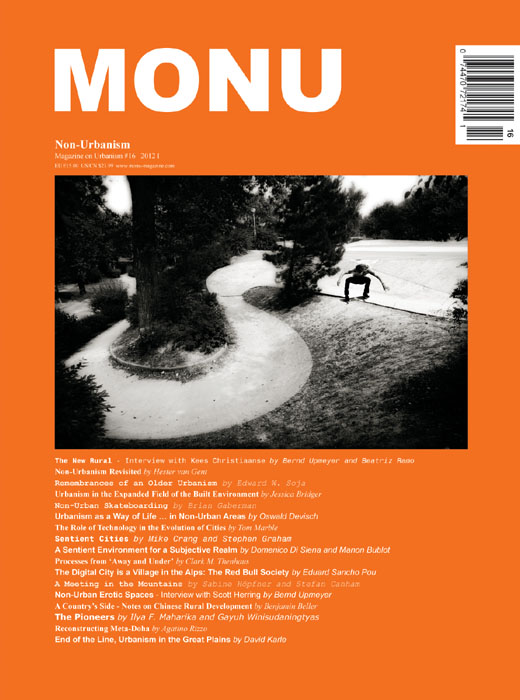
The digital city is a village in the Alps. The RED BULL Society.  (Artículo publicado en MONU #16 - NON-URBANISM, Abril 2012,  Rotterdam- Holanda)
RealizacionesPróxima

The digital city is a village in the Alps. The RED BULL Society. (Artículo publicado en MONU #16 - NON-URBANISM, Abril 2012, Rotterdam- Holanda)

In the digital city, I am awakened by a cow. Not its lowing, but rather its bell, clanging louder than the loudest alarm clock. I am in Fuschl am See, a charming Austrian village on the edge of a no less charming lake. Idyllic all around, wooden houses everywhere ringed by mountains. Just 10 minutes away is St. Gilgen, where Mozart's mother was born and 20 minutes away along a winding road is Salzburg, the city of music. But Fuschl am See is also home to Red Bull, the multinational that sells the world’s most famous energy drink and has revolutionized the concept of sports sponsorship. All of this happens from here, from a place where everything seems terribly boring and isolated from the world. No one would say this village is a digital city.

The changes are subtle. The hotel is sturdy and comfortable. I go down to breakfast and the entire buffet is terribly Austrian, even the coffee. At one table sits Sebastian Vettel, the Red Bull Formula 1 racer. He is accompanied by a few people who are also wearing T-shirts bearing icons of the drink, because the stars Red Bull sponsors come here to train, to take part in the stage. And most of all to have photos taken with which to flood the digital world. Today it is Sebastian, but yesterday it was Henry, the famous soccer player from the French national team who has left Barça to join the New York Red Bulls. They come to a town where no one bothers them, where fame has no consequences, to enhance that fame worldwide.

I leave the hotel and stroll around the village. There is a church, a school, two supermarkets and a slew of houses and apartments for rent. There is a pier overlooking the lake and public swimming pools. All comfortable. All quiet. All exactly the same. You can’t tell who is rich, because the truth is that they are all rich in their own way, since they live in such a privileged place.

Across the road at the end of town are the Red Bull Gmb headquarters. The two main buildings are cones with sliced-off points. The client wanted them to be crater-shaped and somehow it is true that the fire is alive and that infinite data are transmitted to the digital network from there. Four hundred people from all over the world work here. The lingua franca is English and everyone appreciates the quality of life and level of Austrian taxes, one of the EU’s lowest. They are just passing through. Their houses and cars are paid for, because in this new Levittown, you need a car to breathe, to live and especially to escape from such perfection.

The Company controls everything. The Company pays the meals of its employees, who are free to choose the restaurant they wish to dine in every day: the pizzeria by the lake, the sober hotel or the new hotel. They are housed in Company housing. All of it is lovely. And if you rise up in the Company, you have more and more windows with views. It is not a gated community on a physical level. There are no visible barriers, because all the barriers are intangible. If you get sacked, you cannot stay. First, because there is no available supply. Red Bull has bought everything up. Or at least it bids on everything, disrupting the market, while enhancing the value of its assets because of the lack of demand it constantly creates. It has become a feudal lord only because of its employees, a lord that everyone - from hoteliers to politicians - never cease to entertain, because they know that without it they’d never be on the map. In the geographical sense yes, but not digitally.

The new communities bear little resemblance to the gated communities that have been sold to us at astronomical prices until recently. We were led to believe that the future would take place behind a fence with private security, a clubhouse, tennis court and a heated pool. Big mistake. Those barriers that separated us from the world had the function of uniting us with our neighbours, so we could socialize. Of creating a perfect world away from the pollution of the outside world. A mistake, because many people turned to mortgages they cannot keep up with in order to buy that house and furniture and all the rest. And all these amenities, these private gardens and private pools and private security guards are the first to go when you’re broke. The problem is that if you don’t pay, your loving neighbours begin to hate you, to point to you as a debtor and install fingerprint detectors to bar entry to the clubhouse. And that's when you realize that the enemy is inside your residential estate and that this entire wonderful community life is based exclusively on paying fees - and that if the fees are not paid, it means war. People try to sell the houses and nobody wants to buy them, since they are so costly to maintain; it all falls apart with an air of impending doom. In contrast, everything in Fuschl am See is discreetly cosy. Probably because there is a mechanism to ensure your expulsion if you’re not useful to the system. The territory will unceremoniously eject you. In digital cities, the barriers are not physical, but rather economic.

I get in the car and head down the road. I see greenery and cows, but mostly order. My specific destination is Salzburg Airport, Hangar 7. The Navigator takes me there directly. The entire building is made of glass. It's an enormous nave designed to attract the public. On one side is a street and a huge parking lot; on the other, a runway. You enter the hanger and a billionaire’s toy museum appears. Formula 1 cars, race cars, planes, helicopters, jets, all of which are spattered with Red Bull logos. It is a combination museum-gallery that sells glamour. It peddles Red Bull’s image to fans, consumers and TV viewers. It's a trade show with a permanent venue where the products are changing constantly. Across from it is Hangar 8, a machine shop where newly landed artefacts from all over the world are cleaned up. And when they are ship-shape and ready once again, they are taken to Hangar 7 for the public’s enjoyment.

You can eat, drink coffee or buy souvenirs in Hangar 7. You can have a drink at the bar with glass floors suspended from the ceiling. And you think you might see or photograph a star there. It is a huge plateau with lights and music that seeks to generate its own content every day to sell an image, a brand. And few of us realize that it is actually a set where we are turned into characters in the Truman Show.

The key to the digital city is ubiquity, omnipresence. Being able to spread your message anywhere in the world. And to do so, all you need is enough runway to pick up speed and lift. From above, only greenery and more cows can be seen. We can only detect digital cities through the media.

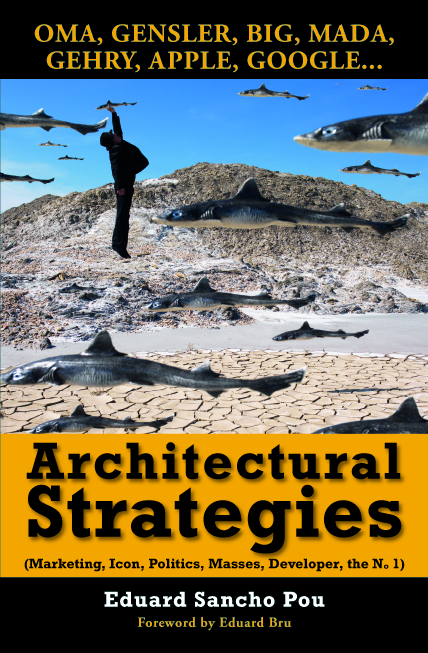
Architectural Strategies (Marketing, Icon, Politics, Masses, Developer, the no.1)
RealizacionesPróxima

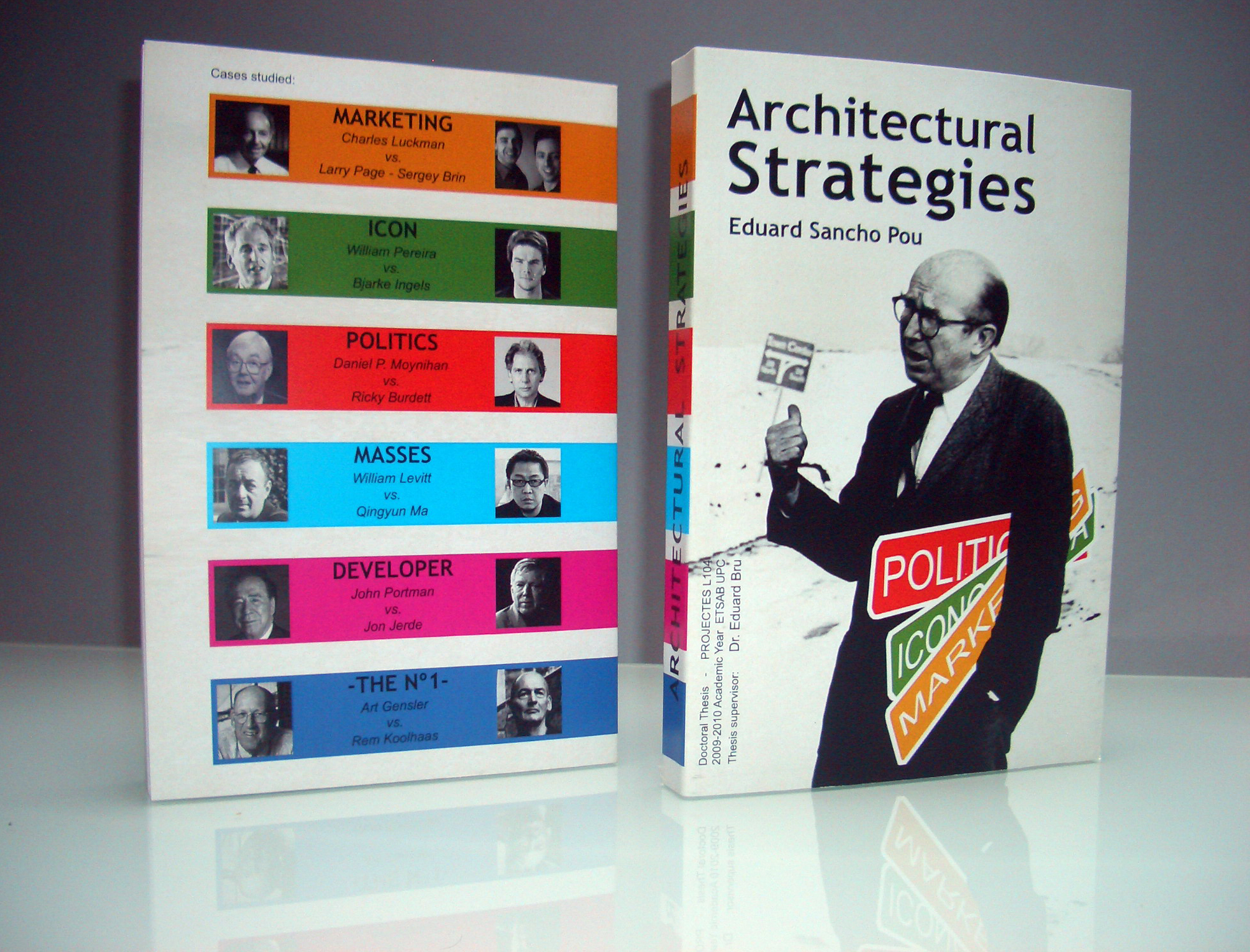
Architectural Strategies (Marketing, Icon, Politics, Masses, Developer, the no.1)

TITLE: Architectural Strategies (Marketing, Icon, Politics, Masses, Developer, the no.1)

AUTHOR: Eduard Sancho Pou / Foreword by Eduard Bru

FORMAT: 15 x 23 cm

PAGES: 208 pages (ills colour & bw, 20 photographs)

BINDING: Paperback

LANGUAGE: ENGLISH

EDITOR: Ediciones Península (Grup 62 - Planeta)

ISBN: 978-84-9942-195-7

PRICE EU: 19,50 €

DISTRIBUTOR: IDEA BOOKS (www.ideabooks.nl) Idea Code 12489

Art Gensler, founder of Gensler, San Francisco: Global firm with more than 3,000 architects and 42 offices worldwide.

“I found your book fascinating and very well done. I believe your concepts in the article Gensler and OMA are correct.”

Bjarke Ingels, founder of BIG, Copenhagen and New York based group of architects. Visiting Professor at the Yale School of Architecture

“Eduard Sancho Pou interprets architecture from the point of view of what seems to work in the complex economic, political, commercial and social reality inherent in today’s global situation. A fresh take on architecture seen through strategy rather than theory.”

Stephen Bates, founder of Sergison Bates architects, offices in London and Zurich. Professor of Urbanism and Housing at TU München.

“The conclusions encourage greater strategic thinking, and this is the books’ most positive message because it promote action in practice, encouraging the architect to instigate, as much as to react.

Manel Gausa, dean of the Institut Arquitectura Avançada Catalunya (IAAC) and director of the Doctoral School of the University of Genova UNIGE.

“This book offers a fresh interpretation of the figure of the architect, which has always been linked to design and is now starting to be linked to entrepreneurial adventure, intellectual adventure and cross-sectional adventure, in which research is fundamental.”

Alfredo Pastor, professor of Economics at IESE Business School and holder of the Banco Sabadell Chair in Emerging Economies, Barcelona

"Architectural Strategies may seem harsh in that it views architects no longer as professionals, but as consultants. Architects must interpret their clients' needs and preferences. And this may lead to a change in the very concept of architecture, while granting priority to the developer's criteria, over any others.”

Qingyun Ma, dean of the University of Southern California’s School of Architecture and founder of the firm MADA spam, Shanghai

"If architecture is about coherent processes, Architectural Strategies starts from disruptive opportunities."

Competitions are Dead. Welcome to Proposals (Artículo publicado en (Non-)Essential Knowledge for (New) Architecture: 306090, Volume 15, Octubre 2013 , New York-Usa) Editor David L. Hays
RealizacionesPróxima

Competitions are Dead. Welcome to Proposals (Artículo publicado en (Non-)Essential Knowledge for (New) Architecture: 306090, Volume 15, Octubre 2013 , New York-Usa) Editor David L. Hays

Arquitecturas de la estrategia (marketing, icono, política, masa, “developer”, Nº 1) Doctorado por la ETSAB UPC Proyectos Arquitectónicos
RealizacionesPróxima

Arquitecturas de la estrategia (marketing, icono, política, masa, “developer”, Nº 1) Doctorado por la ETSAB UPC Proyectos Arquitectónicos

Cada capítulo expone casos reales para establecer un paralelismo entre la trayectoria de un determinado arquitecto del siglo XX y la de un profesional de nuestro tiempo. De los análisis se desprende que las estrategias de venta no son un fenómeno nuevo y que adaptadas, siguen un patrón de uso.

La tesis se apoya en datos biográficos de los arquitectos objeto de estudio para explicar las circunstancias de las que partieron y cómo alcanzaron el éxito o, por el contrario, qué les condenó al fracaso. Me interesa el momento en que, poniendo en riesgo su vida profesional, apuestan por una estrategia que el mercado decide si es correcta o no.

Curiosamente, las investigaciones me han llevado a definir tres características comunes a todos los arquitectos que utilizan la estrategia: Les gusta más construir que proyectar; son hábiles oradores y tienen relación con la Costa Oeste de los Estados Unidos.

California es un lugar de oportunidades donde el resultado importa más que la teoría. Allí, todos trabajan con estrategias para lograr beneficios. En la zona han nacido o desarrollado su labor profesional Gehry (vive en Santa Monica), Gensler (vive en San Francisco), Luckman (trabajó en L.A.), Pereira (es de L.A.), Ma (es el decano de la USC de L.A.), Jerde ( trabaja en L.A.), Koolhaas (a partir del proyecto del edificio de la Universal en L.A. crea Amo), Jobs (es el fundador de Apple y trabaja en Cupertino) o Page y Brin (son los fudadores de Google y estan en Palo Alto).

Sorprenderá mi inclusión de arquitectos de software en la lista de arquitectos de edificios. El cambio que ha vivido la arquitectura lo justifica. En la actualidad, las empresas ya no encargan edificios que las representen, sino estrategias que mejoren su marca, su eficiencia y sus ventas. Ofrecerlas es hoy también trabajo de un arquitecto.

El desafío es grande y más aún en el contexto actual. La crisis está provocando cambios en el perfil del arquitecto. Pasamos de hablar un lenguaje que sólo entendemos nosotros –el discurso arquitectónico–, a un lenguaje que entienden todos, menos nosotros: el discurso estratégico.

A día de hoy, los arquitectos proyectaremos menos edificios, para centrarnos en proyectar estrategias. Empecemos pues a estudiarlas. Descubriremos cómo funcionan y hasta dónde nos pueden llevar. De buen seguro las vamos a necesitar para convencer a la sociedad de que todavía podemos serle útiles.

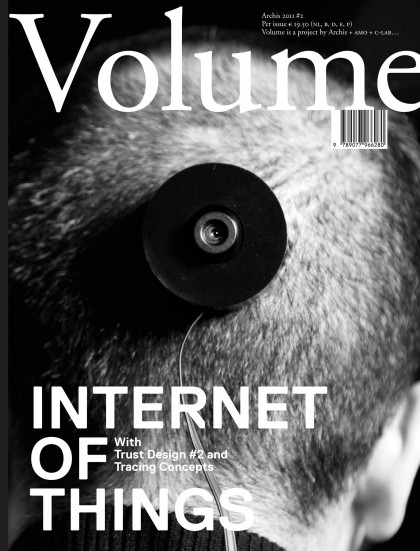
All that is material will be standard, and all that is personalized will be virtual (Articulo publicado en Volume 28, Julio 2011, Amsterdam-Holanda)
RealizacionesPróxima

All that is material will be standard, and all that is personalized will be virtual (Articulo publicado en Volume 28, Julio 2011, Amsterdam-Holanda)

The largest migration in human history is looming. And if we are impressed now by Shanghai - with its ten million inhabitants - in 20 years, there will be ten new satellite towns in its perimeter, which will make the city swell to 100 million people.

To create hyperdense cities, architects must also think about the social relations to be established; they cannot limit themselves to constructing buildings. They must consider how to coordinate future life in the cities and help the public get ready to inhabit them.

The solution will tend towards an updated version of Levitt’s work. The way to optimize the production chain will be sought for reasons of sustainability and economic profitability. An efficient, cheap and quickly-built system needs to be defined to ensure minimum conditions of quality for the population. The solution must be a temporary one that consists in easily assembled, small accommodations clustered in high density. The housing’s uniqueness will need to be developed so that its inhabitants enjoy some degree of comfort. Just as the rise of the automotive industry made the commute to Levitt’s homes possible – which led to individualized travel –a technology that allows people to live in hyperdense cities will need to be developed.

The technology that will lead us to create this new way of life will be the virtual environment (the 3D environment of a fantasy world in which each person is represented by an avatar). New technologies change social relations as well as our personal experiences. We use them to replace basic aspects of our existence such as living, feeling and touching with browsing, accessing or customizing. We need another kind of reality that allows us to survive emotionally. The virtual world allows a person who lives in a huge block, in a giant hive, to keep one’s “virtual self” in the town where he was born and has always dreamed of living. It gives one access to what one cannot actually have or to the friends left behind in the move from the countryside to the city. The Chinese can adapt to this way of life because physical objects have no value except in the relationships they create. The new generations, who are teens today, no longer distinguish between the virtual and real worlds. It is all the same thing, although virtuality is closer to their way of understanding life. Instant messaging and Facebook allow them to be instantly close to their friends, music, vacations and interests. What they see on a daily basis is boring in comparison with the inputs they receive from their virtual friends. Their physical environment no longer is important if they have access to the Internet. And that is the citizen who can survive in an hyperdensified environment: someone who does not need the material public space because he or she will find it in the virtual space, someone who will find everything related to the personal virtually because physically he will not be able to pay for it or simply because it is not worth acquiring something that means a burden on their extreme mobility.

The shift has already begun. The virtual world is intertwined with reality. Renderings convince politicians and decide competitions that become built realities. Their glitter and lights attract the masses. The strange thing is that built architecture is ever closer to that virtual architecture.

In the end, all that is material will be standard, and all that is personalized will be virtual. Unique pieces will be unsustainable because of price and energy expenditure, if we wish to supply the masses. This may sound like science fiction, but the virtual world will be the technology we use to define the super-dense city.