Shrinking Villages propone una mirada en positivo hacia el abandono rural, a base de una serie de estrategias de desarrollo y de posibles escenarios futuros para los pueblos del Valle de Valverde, en Zamora.
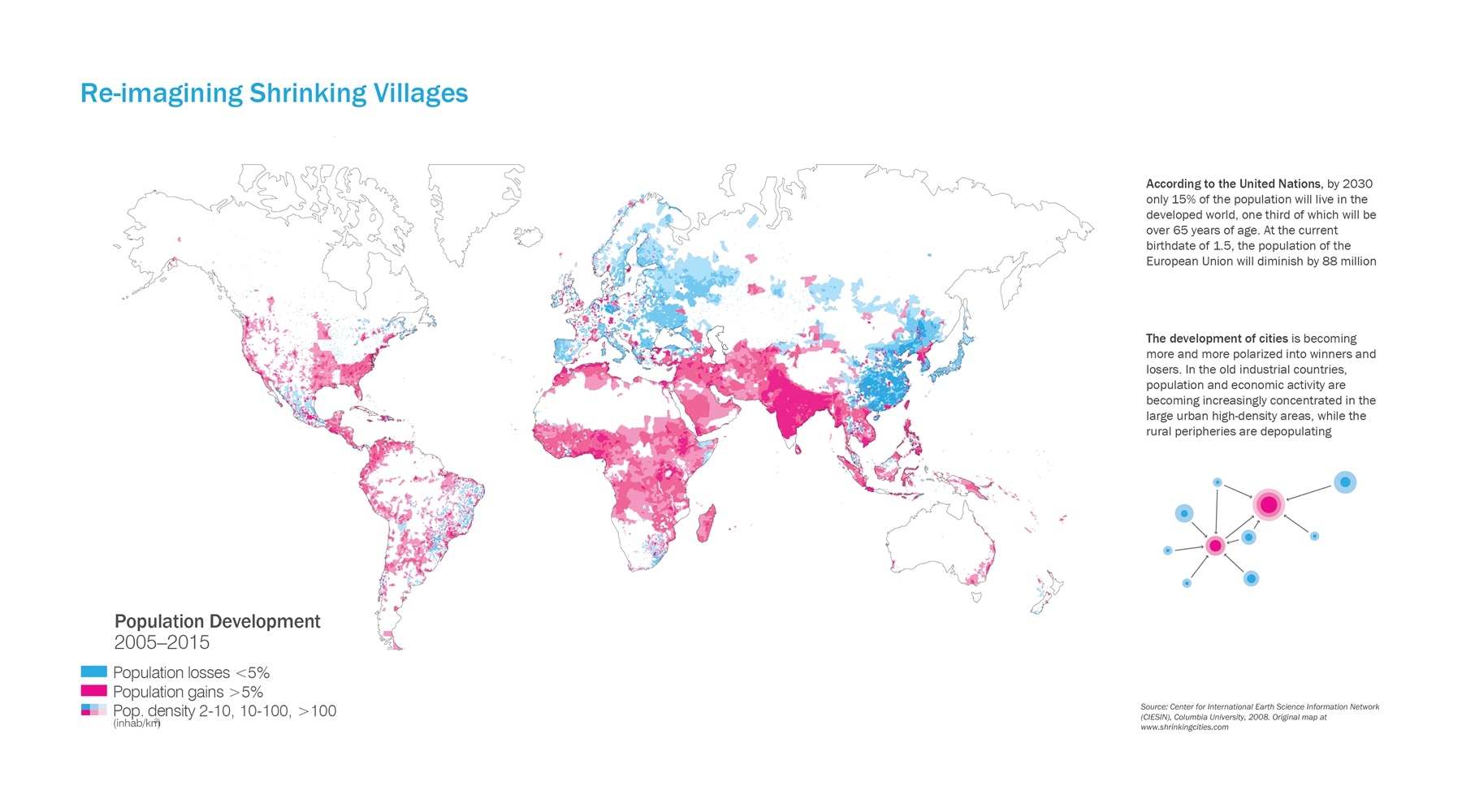
Like all rational practices of the past two centuries, the discipline of architecture has been centered on the assumption of growth. Current projections on world population and urbanization keep justifying this argument [1]. However, not all the cities and regions are growing. In the 1990s international studies showed that more than a quarter of large cities worldwide already shrank [2], and as a general foresight, it is estimated that between 2070-2100 the world population will reach its zenith; then, processes of growth and shrinkage will reach a balance, and decline will be as common as before industrialization began [3].
While there are clear approaches towards growth and development as additive philosophies, there are no evident frameworks for shrinkage or subtraction beyond contexts of decay and abandonment. Today it seems that the modern idea of growth is so firmly anchored in our thought processes that any reduction can only be interpreted as a loss. The challenge, consequently, seems to be rooted in the conceptualization of shrinkage as a design problem. Therefore, and since the investigative framework on shrinkage is empirically based on case study analysis, the research on one example can be used as a tool for both understanding its specific patterns of change and reformulating this question.
Rural areas suffer the double neglect of being excluded from standard statistic studies [4]. Today almost 3,000 Spanish villages (out of a total of more than 24,000, what represents a 12.5%) are abandoned and a non-registered number of them are immersed in disappearing processes. Ageing population, abandonment of agricultural activity, and youth flight to the city are some of the current issues. Latest polemics about the fight of several municipalities for hosting a nuclear cemetery, disregarding potential risks for its population with the only objective to “survive”, is only one sample of this situation, and despite the fact that Spain’s policies developed for them until date have focused in retaining population, this has been shrinking for the last 50 years. Consequences of rural flight are also largely affecting Spanish landscapes, amanipulated natural system [5]: As livestock farmers abandon the land, wilderness takes over, leading to the homogenization of the landscape, loss of biodiversity, erosion and desertification of areas with propensity to aridity [6]. Through the analysis of a case study, Valverde valley (10 villages characterized by agriculture production since cattle is the first business to be abandoned), and under the certain process of change towards new social and economic models, one can realize that the rural is transitioning to other emerging contemporary uses, and only human intervention can act as a trigger for new productive and ecological scenarios. Its abundant available land implies flexibility for other uses, as well as some immediate and bottom-up actions such as recent trends of eco-villages settled up by youths as an alternative to city lifestyle and self-reliance, slow-food followers, retired elderly, and anyone who wants to run from the crowded city because it is able to absorb and survive to economic, energy and ecology crisis. However, these new occupancies don’t really deal with the current social and economical problems in the rural environment; the identity of this landscape is not contemplative (or leisure), but productive, what forces us to rethink the rural as we have traditionally understood it: Are there alternatives to these obsolete policies? Can shrinkage be transformed into an opportunity for design interventions?
There exists a need to explore alternatives to current policies, fly over the situation with certain perspective, free from prejudice and inertia, and build new models. The research will be used as a way to identify the opportunities beneath the Problem in order to re-conceptualize it and transform it into a Topic. Somehow, although we have all been and keep being trained to see in a certain way, there is a gap in thinking of this subject as a field for potential “architectural” performance. The role of the designer may be transitioning from thinking of objects to active agents in the formulation of catalysts and processes; in this sense, strategies and scenarios are intended to open up our imagination towards more creative ways of dealing with the unavoidable, because, if growth is physically impossible everywhere but we can’t find profitable provocations for shrinkage, who will want to embrace it?
[1] “By 2030 more than a 60% of the world’s population will be living in urban areas”. UN Report.
[2] Atlas of Shrinking Cities. Hatje Cantz, 2006
[3] Ibid
[4] Usually over 100,000 inhabitants
[5] In the article “Mundo Rural: Un Paisaje sin Dueño” , (Rural World, a Landscape without owner) ational Congress on Environment, 2008. Available athttp://www.conama9.org
[6] Ibid